The Nature of Attention..

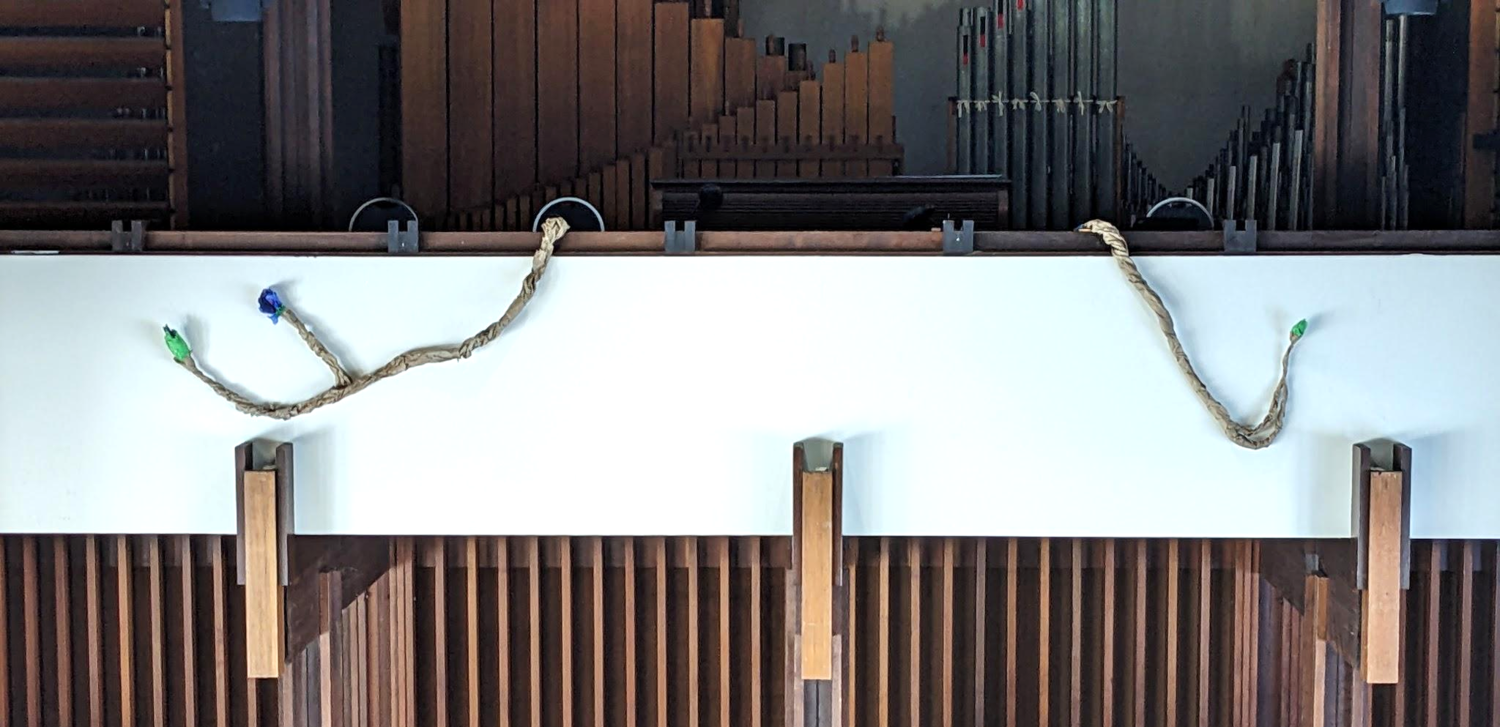
Sacred space is artistic space. Centered around shared community values, our sanctuary is place for vision, creativity, transformation, and expression. Each month, the sanctuary changes a bit, connected to a monthly theme. March's 'big idea' is: Paying Attention.
"The Nature of Attention" is an evolving meditation on attention and how nature patiently restores it.
The piece draws viewers in through familiar, organic shapes—branches that fork and reach, echoes of roots, rivers, and cellular and neural pathways. These forms suggest that the psyche is not separate from nature but mirrors it. The mind branches in search of meaning, like a plant turning toward light—rooting deeply in some places, sending quick new shoots in others, growing according to its own inner design.
Shadow plays a central role in the work. Light filters across the shapes, casting subtle silhouettes that extend beyond the foreground. Viewers are invited to attend not only to what is directly illuminated, but also to what lingers at the edges of perception. In doing so, the piece gestures toward a broader awareness: attention is shaped as much by absence and negative space as by presence.
The work unfolds at a slower tempo, evolving over the span of a month as subtle shifts mark the passage of time. Change is constant, and attention becomes an act of return—what was unseen yesterday may emerge tomorrow. As perception softens, attention need not be forced into one channel but allowed to branch and wander. In this rhythm, divergence is not corrected but honored. The mind’s branching is not disorder—it is forest.
Research shows that just 10–20 minutes in nature—a “nature pill”—can lower stress and cortisol, ease rumination, steady heart rate and blood pressure, and sharpen focus. "The Nature of Attention" translates these findings into space. Surrounded by windows that draw the outdoors inward and echo the work’s branching forms, this installation offers a sustained invitation to notice natural rhythms, providing physiological and psychological recalibration through stillness, reflection, and return.
Ultimately, the piece proposes that attention is not something we force, but something we tend. By returning, by lingering, by noticing the slow evolution of form and shadow, viewers participate in the quiet transformation the work embodies.

About
-
UUSGS Meetinghouse